
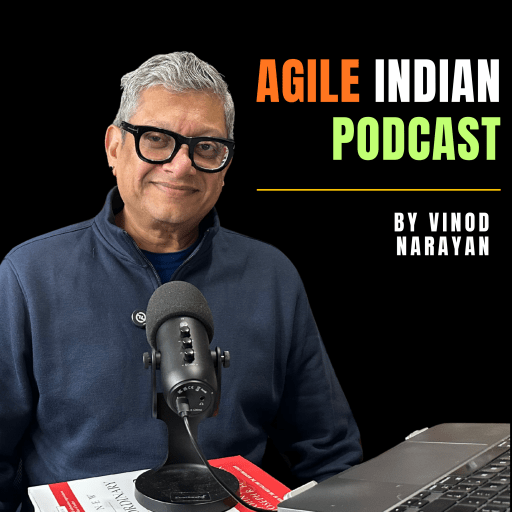
After the last episode, I was thinking about Agile Indian. If you take the first two letters, it becomes AI. Not that it signifies anything, but I found it interesting because I had never thought about it before.
That thought led me to think about the world many of us were born into.
I was born in the early 1970s in Kerala. It was a very different world. We did not have television. Mobile phones came much later, well into my adulthood. I think I got my first phone many years after I started working. There was no internet, no phone, nothing. It was a very different world.
We spent most of our time playing outside, climbing trees, falling from them. I am not saying that everything we did as kids was right. I think children today have a much better sense of equality and friendship.
When you look at any time period, there are things we think are good and things we think are not good. In hindsight, we understand what was wrong with that time.
I grew up in a very privileged setup. My family was well off. My parents had jobs. I say privilege because it is important for us to talk about privilege.
Recently, I was at a party in the US. Most of my friends there were immigrants from India who have lived here for thirty years. I told them that we are in the US because we were privileged even in India. Many people agreed.
Even if we had never come to the US or gone abroad, we would still have had a good life in India. Many people we studied with never left India and are doing well. Yes, some people move abroad and face difficulties and lose everything, but the majority of people who came here were privileged even back home.
Sometimes it is difficult for individuals to acknowledge that they were privileged. People like to tell stories of struggle. Everyone fights battles in life, but struggle has nothing to do with whether you are privileged or not.
I want to be clear about my own story. I did not struggle. If I struggled in any way, it was because of my own decisions. I screwed things up, and as a result, I struggled.
My upbringing, my family, my community, my education, my opportunities, even getting my first job — I was extremely privileged. The moment I acknowledged that, I became more empathetic toward people who are not privileged.
Privilege is not just about money. It is also about freedom — the freedom to think, to choose a career, to choose a life.
There is also male privilege. Growing up in India as a boy, I had privileges that women did not. That privilege needs to be acknowledged if we are to talk meaningfully about equality — gender equality at home, in society, in education, and in the corporate world.
The 1970s were a different time. I don’t know what my earliest memory really is. Many memories are reconstructed over time. I spent a lot of my vacations at my mother’s ancestral home. It was a large house. She had many siblings. She was the eldest, and I was the eldest grandchild. I was extremely pampered.
I saw privilege even more clearly when other children were born later. Acknowledging that privilege has made me more considerate about what we should do as individuals.
It is easy to say we were not privileged because we didn’t have phones or internet. That is not how privilege works. Those things didn’t exist. Privilege exists within the context of the time.
I think conversations about privilege should happen with children, irrespective of where you live. They should understand what privileges they have and how life is different for people who are less privileged.
Religion existed when I was growing up, but it never defined friendships. I knew what religion my classmates followed, but it never mattered. Today, religion seems to be something people foreground constantly.
Religion can have significance in someone’s personal life, but it does not need to dictate how others live. If your religion says you shouldn’t drink, then don’t drink. But don’t stop others. If your religion says you shouldn’t eat certain food, then don’t eat it. But don’t impose it on others.
I am an atheist. I was born a Hindu, but I do not practice religion. Some people find it difficult to accept that. I tell them that if someone else’s atheism bothers you, maybe you are not fully secure in your own belief system.
Looking back, many people I knew were rational thinkers without having to deny the existence of God. Things were simpler.
Personally, life felt easier for me — because I was privileged. Privileged in my family background and privileged as a man.
I will see you all next week. Some topics may resonate with you, some may not. You can also listen to Agile Indian on Spotify.
Take care. Thank you.
 Agile Indian